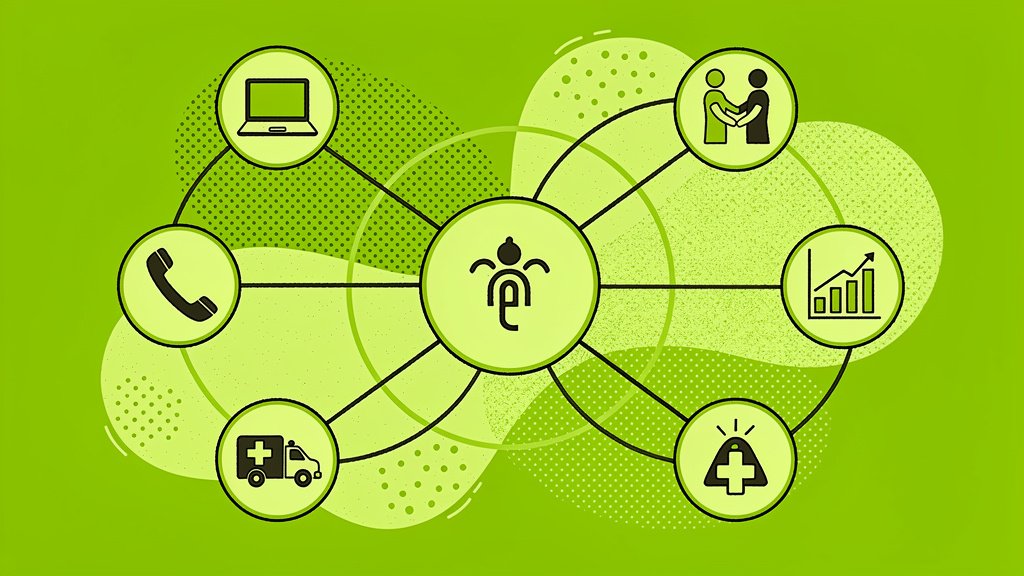
When disaster strikes, you can’t afford coordination failures. Yet here’s what we see all the time: nonprofits running disconnected systems that turn urgent moments into complete operational chaos. The gap between your crisis response intentions and what actually happens often comes down to one thing: whether your technology works together or against you.
Look, integrated tech systems are the difference between scrambling through spreadsheets while donors wait for updates and mobilizing coordinated action within minutes. For US nonprofits facing escalating demands and shrinking resources, connected technology infrastructure isn’t some luxury. It’s survival.
The Real Cost of Disconnected Systems
You know this frustration intimately. Your donor database doesn’t talk to your volunteer platform. Email campaigns run separately from your CRM. Financial data lives in isolation from program metrics. And when a crisis hits? This fragmentation becomes catastrophic.
A national survey found that budget shortages and coordination issues with partners consistently impede effective crisis communication for US nonprofits (Sage Journals). But the consequences go way beyond inconvenience.
- manual data entry across platforms wastes hours that could save lives,
- teams lack real-time visibility into donor commitments or resource availability,
- communication happens through fragmented email chains that collapse under pressure,
- volunteer apps that don’t sync with fundraising tools create mobilization delays exactly when speed matters most.
Research on food networks during COVID-19 exposed how overnight operational shifts revealed governance gaps and volunteer no-shows when organizations lacked integrated oversight systems (PMC). These aren’t hypothetical scenarios. They’re documented failures that integrated systems prevent.
Daily Struggles We See Before Nonprofits Make the Switch
The 3 AM panic: An executive director realizes their emergency appeal went to the wrong donor segment because the marketing platform didn’t sync with recent giving data. By morning, they’re sending apology emails and losing momentum during the critical first 24 hours of crisis fundraising.
The volunteer mismatch: A disaster response coordinator has 200 willing volunteers but no efficient way to match skills with urgent needs. Why? Because volunteer management software operates separately from the incident tracking system. Volunteers receive conflicting instructions through different channels, creating confusion instead of coordination.
The reporting nightmare: A development director spends the board meeting apologizing for outdated numbers because pulling crisis response metrics requires manually combining data from five different platforms. The board questions operational competence when the real issue is technological fragmentation.
Hm, even organizations using Funraise sometimes struggle when they haven’t fully leveraged integration capabilities. Connecting their existing tools creates exponential value beyond any single platform.
Protip: Conduct a quarterly tech stack audit. List every tool your organization uses and map how data flows between them. The gaps you discover? Those represent your coordination vulnerabilities during the next crisis.
Understanding Integrated Tech Systems
Integrated tech systems connect your CRM, donor platforms, communication tools (Slack, Zoom), and analytics through APIs that enable seamless data flow. Unlike patchwork setups held together with manual exports and prayer (we’ve all been there), integrated systems create a unified ecosystem where actions in one platform automatically trigger appropriate responses across others.
When a donor makes a gift during a crisis appeal, truly integrated systems don’t just record the transaction. They update the donor’s profile, trigger personalized acknowledgment, adjust real-time fundraising dashboards, notify relevant team members, and potentially activate volunteer matching. All without human intervention.
Core components include:
- central CRM hubs that serve as your single source of truth for constituent data,
- automation layers that execute workflows based on real-time triggers,
- cloud-based communication systems enabling remote coordination,
- analytics dashboards that aggregate data across platforms for unified insights.
Organizations using Funraise’s ecosystem experience 73% annual online giving growth (Funraise) partly because integration eliminates friction at every donor touchpoint. One food bank implemented Salesforce integration to streamline crisis operations, transforming their response capacity (Team Heller).
The Numbers Don’t Lie: Crisis Pressures Demand Better Systems
US nonprofits face a perfect storm that makes coordination failures especially dangerous. 71% of organizations report increased program demands, while 74% struggle with job vacancies (ForvisMazars). The resulting strain forces impossible choices: 68% plan to reduce services within 1-2 years (ForvisMazars).
| Challenge | Percentage Affected | Impact on Crisis Response |
|---|---|---|
| Rising operating expenses | 46% | Less budget for emergency reserves |
| Inadequate finances/resources | 42% | Delayed crisis mobilization |
| Limited staff capacity | 37% | Coordination falls to fewer people |
| Staffing recruitment/retention issues | 30% | Institutional knowledge gaps |
Data source: ForvisMazars 2024 State of the Nonprofit Sector Report
Organizations using integrated systems counter these trends. Funraise users grow online revenue 3x faster and achieve 52% recurring revenue growth annually (Funraise), building the financial resilience that crisis response requires. When you’re doing more with less, technology integration multiplies limited staff capacity.
“The organizations thriving today aren’t necessarily those with the biggest budgets. They’re the ones that made their systems work smarter, turning coordination chaos into competitive advantage.”
Funraise CEO Justin Wheeler
Speed and Scalability: Integration’s Core Benefits
Integrated systems slash response times by automating workflows that otherwise consume precious hours during crises. Real-time data unification means leadership makes decisions based on current information rather than yesterday’s reports.
Consider mobilization speed: when volunteer apps sync with donor databases, you instantly match skilled supporters with urgent needs. Resource optimization improves as unified dashboards predict requirements, reducing waste when every dollar counts. Donor retention strengthens through personalized crisis outreach that reflects complete constituent history.
In our experience, Funraise analytics users achieve 7x higher annual online fundraising with 12% better donor retention (Sisense). These metrics prove especially critical for maintaining support through extended crises. During COVID-19 responses, remote coordination tools like Zoom and Trello sustained operations when physical gatherings became impossible (Funds for NGOs).
The efficiency gains aren’t marginal. They represent the difference between organizations that scale impact during crises and those that collapse under operational burden.
Protip: Start small with integration. Connect one high-pain tool (your CRM plus email platform) using no-code solutions like Zapier. Quick wins build organizational confidence for broader integration projects.
Your Crisis Coordination AI Assistant: A Ready-to-Use Prompt
Copy and paste this prompt into ChatGPT, Claude, Gemini, or your preferred AI tool to design a crisis response coordination plan:
I need help designing a crisis response coordination plan for my nonprofit. We currently use [DESCRIBE YOUR MAIN SYSTEMS: CRM, communication tools, volunteer platform, etc.] to manage operations.

Our typical crisis scenarios include [DESCRIBE 1-2 CRISIS TYPES: natural disasters, funding emergencies, program disruptions, etc.].

Our coordination challenges during past crises have been [LIST 2-3 SPECIFIC PROBLEMS: communication delays, volunteer confusion, donor data gaps, etc.].

Create a step-by-step integration strategy that connects our existing tools for faster crisis response, identifies the top 3 automation workflows we should implement first, and recommends metrics to measure coordination improvement.
While AI tools provide valuable planning support, daily workflow efficiency comes from purpose-built nonprofit solutions like Funraise that embed AI functionality directly where you work. Context-aware AI that understands your donor history, campaign performance, and organizational patterns delivers insights generic tools can’t match.
Technology Tools Transforming Crisis Coordination
The nonprofit tech landscape offers specialized tools across multiple categories, each solving specific coordination challenges. But here’s the thing: the key isn’t adopting every platform. It’s ensuring your chosen tools integrate effectively.
Donor and CRM Systems: Platforms like Funraise and Salesforce Nonprofit Success Pack centralize constituent data, enabling synchronized gift processing, volunteer dispatch, and communication tracking. Integration benefit? A single donor action triggers coordinated responses across teams.
Communication Platforms: Slack channels, SMS systems, and video conferencing keep distributed teams aligned. Integration benefit: real-time partner alerts based on CRM triggers rather than manual notifications.
Analytics and Prediction: Forecasting software identifies demand spikes before they overwhelm capacity. Integration benefit: predictive insights that automatically adjust resource allocation and fundraising appeals.
Volunteer Management: Mobile apps enable geo-targeted coordination, matching skills with needs. Integration benefit: volunteer availability syncs with crisis incident tracking for instant deployment.
Here’s an unconventional approach gaining traction: embed AI chatbots for 24/7 donor triage during off-hours crises. Funraise’s AI capabilities forecast giving trends and auto-segment urgent appeals (Funraise Blog), ensuring crisis fundraising continues even when staff sleep. Team Rubicon unified multiple SaaS applications for disaster survivor tracking, demonstrating integration’s power at scale (Team Rubicon USA).
Real Organizations, Measurable Results
PanCAN integrated patient systems with Salesforce Nonprofit Cloud, enabling seamless crisis pivots when operational priorities shifted suddenly (Team Heller). The unified view let them maintain service quality despite disruption.
Lions Clubs International leveraged mobile apps and virtual platforms during COVID-19 to enable virtual fundraisers and coordinate food drives when in-person events became impossible (Psicosmart). Integration maintained donor engagement through channel shifts.
Team Rubicon’s digital transformation connected volunteers and donors across disaster responses, creating coordination capacity that manual systems could never achieve (Team Rubicon USA).
A nonprofit facing a security breach contained the incident through expert tech volunteers coordinating via partnered platforms. Integration enabled rapid specialized response (Apparo). Funraise powered Innocence Project to raise $10 million in 16 months (Vanderbloemen), demonstrating scalability that applies equally to crisis campaigns.
These cases prove that automation transforms integration from theoretical benefit to mission multiplication.
Your Implementation Roadmap
Building connected crisis response doesn’t require ripping out existing systems overnight. We’ve found this practical sequence works:
Step 1: Inventory Current Tools – Document every platform, system owner, contract terms, and user counts. Understanding your starting point prevents duplicate functionality and identifies integration opportunities.
Step 2: Prioritize Integration Projects – Connect your CRM to communication platforms first. Data integrity at the constituent level enables every downstream coordination improvement.
Step 3: Automate Critical Workflows – Design trigger-based actions: new crisis donation leads to personalized thank-you SMS leads to volunteer opportunity invitation. Start with your highest-volume, most time-consuming processes.
Step 4: Test Through Crisis Drills – Annual simulations reveal integration gaps before real emergencies. Practice activating your connected systems under time pressure.
Step 5: Review and Adapt Annually – Technology and organizational needs evolve. Schedule quarterly check-ins and annual comprehensive reviews to maintain coordination effectiveness.
Funraise offers 100+ integrations for plug-and-play connections with leading CRM, event, and communication platforms (Funraise Integrations). You can start with the free tier to test integration concepts before scaling.
Protip: Identify “tech champions” across departments. Staff members who understand both the technology and workflow needs. They become your integration implementation team and ongoing troubleshooters.
Future-Proofing Your Crisis Capacity
AI and predictive analytics represent the next coordination frontier. Expect embedded intelligence that forecasts crisis scenarios, automatically adjusts resource allocation, and provides decision support during high-pressure moments. Funraise’s Fundraising Intelligence already delivers predictive donor insights that increase annual fundraising 7x for analytics users (Sisense).
An unconventional edge to consider: blockchain-based aid tracking for transparent crisis fund management. Donor trust during prolonged emergencies depends on demonstrating impact. Distributed ledger technology provides verifiable accountability that traditional systems can’t match.
The coordination demands aren’t decreasing. 85% of nonprofits expect service growth in 2025 (Mazlo) despite the resource constraints documented earlier. Organizations building integrated tech infrastructure today position themselves to meet that demand rather than rationing impact.
Proving Impact Over Overhead
Connected crisis response systems align perfectly with the principle that real impact matters more than minimizing overhead. Yes, technology integration requires investment. But the alternative? You’re burning donor dollars on coordination inefficiency that prevents mission achievement.
When your systems work together, you demonstrate that every contributed dollar flows to coordinated action rather than administrative friction. Transparency improves because unified dashboards reveal real-time impact. Donor confidence grows when crisis appeals trigger visible, immediate responses.
Technology integration isn’t about chasing trends. It’s about turning good intentions into efficient, measurable action exactly when communities need you most. The nonprofits thriving through crisis after crisis aren’t lucky. They built the connected infrastructure that makes coordination automatic rather than heroic.
So start where you are. Audit your current systems. Identify one painful coordination gap. Connect two tools that solve it. Then scale from there.
Funraise’s platform was built specifically for this journey, whether you’re just beginning integration or ready to leverage advanced AI capabilities. The free tier lets you test concepts without commitment, and the ecosystem grows with your coordination needs.
The next crisis is coming. Your systems are either ready or they’re not. Choose connection over chaos.
About the Author


Beginner's Guide to Claiming Your Nonprofit Property Tax Exemption
Look, property tax exemptions might be one of the most overlooked opportunities in the nonprofit world. While you're busy optimizing overhead ratios and perfecting donor acquisition strategies, there's this straightforward way to redirect thousands of dollars annually toward your actual mission. We're talking serious money here. Back in fiscal year 2009, U.S. property tax revenues…
Modern Humanitarianism: Why Digital Logistics and Local Procurement Trump Traditional In-Kind Aid
So here's the thing about modern humanitarian aid: we're still shipping blankets halfway around the world when there's a perfectly good blanket factory down the road from where they're needed. Look, traditional in-kind aid (you know, collecting donations and physically shipping stuff overseas) made sense in a different era. But digital logistics and local procurement…

Sustainable Scaling: Balancing Burn Rates and Long-Term Operational Efficiency in Growing Nonprofits
Sustainable Scaling: Balancing Burn Rates and Long-Term Operational Efficiency in Growing Nonprofits Growth feels like success. More programs, more staff, more impact, right? But here's the uncomfortable truth: unchecked expansion is draining nonprofits dry. When your burn rate outpaces your revenue, you're not scaling sustainably. You're building a house of cards. At Funraise, we've spent…