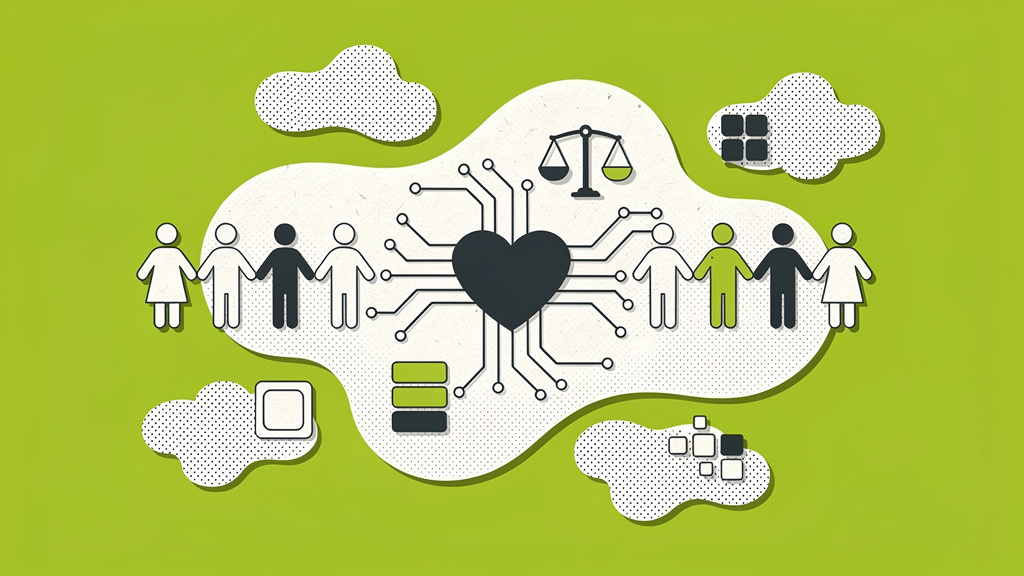
Look, here’s the thing: we’re living through a moment when AI is reshaping entire industries, and nonprofits are watching this transformation wondering where they fit in. It’s not just about adopting new tools anymore. It’s about proving that your organization delivers something irreplaceable, something that algorithms can amplify but never truly replicate.
So let’s dig into the fundamental question: why do nonprofits exist in the first place? At their core, they fill critical gaps left by government and for-profit sectors, delivering essential services, fostering community, and upholding what we call the social contract. That’s basically a mutual agreement where society collectively addresses needs beyond what markets or governments can handle (Council of Nonprofits). In the AI era, this role doesn’t disappear. It transforms. And the challenge lies in proving that nonprofits deliver irreplaceable, human-centered impact.
The Foundation: Why Markets and Governments Aren’t Enough
Nonprofits emerged in the U.S. because governments couldn’t fully fund certain public goods and markets deemed them unprofitable. Think education for underserved populations, disaster relief, arts programs, poverty alleviation (Arkansas State University). Rooted in traditions of mutual aid and charity, these organizations eventually formalized under the 501(c)(3) tax code, enabling tax-exempt operations focused on mission over profit.
The drivers behind nonprofit growth? They’ve stayed remarkably consistent:
- Market failures: Services like community arts or crisis intervention lack profit incentives, leaving vulnerable populations without support,
- Government limitations: Even in affluent nations, tax revenues can’t cover every social need,
- Civic innovation: Citizens collaborate to advance ideals like equality, justice, and compassion that transcend electoral cycles.
Today, the U.S. has nearly 2 million nonprofits, including 1.48 million 501(c)(3)s (USAFacts). By embodying democratic ideals and turning shared values into action, nonprofits strengthen the social fabric in ways both measurable and intangible.
Protip: Map your programs against existing government services in your region. You’ll identify partnership opportunities where you can complement rather than duplicate efforts, scaling impact without wasting resources.
The Social Contract Made Tangible
Social contract theory posits that citizens surrender some freedoms for government protection of rights and welfare. Nonprofits extend this contract by voluntarily tackling obligations the state can’t or won’t fulfill: equity, compassion, innovation in service delivery (NCBI). They act as stewards, bridging state shortfalls through trust-based partnerships with communities.
Here’s how nonprofits operationalize the social contract differently than government:
| Aspect of Social Contract | Government Role | Nonprofit Role | Example Impact |
|---|---|---|---|
| Basic Needs | Funding programs | Direct delivery | Feeding and sheltering millions annually |
| Equity & Justice | Policy-making | Advocacy and research | Dismantling barriers for vulnerable populations |
| Community Building | Infrastructure | Engagement and events | Fostering belonging via arts and culture |
| Economic Support | Regulations | Job creation and training | Employing 12.8 million (10% of private workforce) |
This complementary position prevents total reliance on imperfect state mechanisms while maintaining democratic accountability. Nonprofits advocate for justice, empower marginalized groups, and build social cohesion (Transparent Hands). These are roles government often delegates due to capacity constraints.
Daily Struggles We See at Funraise
Before nonprofits discover comprehensive solutions, we witness recurring challenges that threaten their ability to uphold the social contract. And honestly, we’ve seen these patterns play out hundreds of times.
The data disconnect: Organizations collect mountains of donor information across platforms (CRM, email, events, social media) but can’t synthesize it into actionable intelligence. They miss retention signals, duplicate outreach efforts, and struggle to prove ROI to board members demanding accountability.
The capacity trap: Small teams spend 15-20 hours weekly on administrative tasks like manual receipt generation, spreadsheet updates, and disjointed reporting. This administrative burden steals time from relationship-building and program delivery. You know, the actual human-centered work that justifies their existence.
The technology paradox: Leaders know they need modern tools but face paralysis choosing between dozens of point solutions. They fear expensive migrations, staff resistance, and vendor lock-in, so they stick with inadequate systems that compound inefficiencies.
These aren’t hypothetical scenarios. We see them daily with nonprofit leaders before they consolidate their tech stack or adopt integrated AI capabilities. The good news? These challenges have solutions grounded in the same principle nonprofits champion: meeting people where they are with the right tools at the right time.
Economic Power Meets Existential Questions
Nonprofits drive U.S. economic vitality, with 1.97 million organizations generating over $2.46 trillion in annual expenses and employing millions (Business Initiative). They contribute measurably to GDP growth, local job markets, and innovation in sectors like healthcare and education (JWC Couch Foundation).
America’s 1.3 million charitable nonprofits serve every demographic, enhancing communities coast-to-coast (Council of Nonprofits). Despite this scale, funding shortages persist, reinforcing nonprofits’ necessity amid ongoing fiscal pressures.
But scale alone doesn’t answer the fundamental question: What makes nonprofits irreplaceable in an era when AI can automate service delivery, predict donor behavior, and even generate empathetic communications?
Protip: Calculate your organization’s local economic multiplier. Jobs created, vendors supported, volunteer hours contributed. Present this data alongside program outcomes to demonstrate you’re not just doing good; you’re building economic resilience that benefits the entire community.
AI’s Double-Edged Transformation
AI transforms nonprofits by automating tasks. In fact, 82% now use it in some capacity, with organizations reporting 20-30% boosts in fundraising via analytics (Sigma Forces). Tools like predictive donor modeling save 15-20 hours weekly on administrative work, freeing staff for high-value activities.
Yet only 10% of nonprofits have AI governance policies (Sigma Forces), revealing a dangerous gap between adoption and accountability. The technology risks commoditizing routine services if organizations don’t strategically position their unique value.
Here’s an unconventional approach we’ve been thinking about: “AI Shadow Teams.” Pair AI agents with human overseers to simulate full operations like donor communications, program delivery, impact reporting. This exercise reveals which elements genuinely require human judgment, empathy, and trust-building. You’ll discover that while AI excels at pattern recognition and scale, it fails catastrophically at the relational depth that converts one-time donors into lifelong advocates.
Try This AI Prompt to Assess Your Nonprofit’s Unique Value
Copy and paste this prompt into ChatGPT, Claude, Gemini, or your preferred AI assistant:
I run a nonprofit focused on [YOUR CAUSE AREA]. Our primary programs include [PROGRAM 1], [PROGRAM 2], and [PROGRAM 3]. Our target beneficiaries are [BENEFICIARY DESCRIPTION].

Analyze which aspects of our work could be enhanced by AI automation versus which require irreplaceable human skills like empathy, cultural competency, and trust-building. Create a two-column table showing "AI-Enhanced Activities" and "Human-Essential Activities" with specific examples from our programs. Then suggest 3 strategic priorities that position our organization as uniquely valuable in an AI-augmented sector.
While experimenting with AI assistants provides valuable insights, consider solutions like Funraise that embed AI functionality directly into your fundraising workflows, maintaining full context of your donor relationships and organizational goals without requiring constant prompting.
Reaffirming the Contract Through Measurement
In the AI era, nonprofits must pivot to high-touch impact measurement, proving ROI on human elements like storytelling and advocacy that AI augments but doesn’t replace. This shift aligns perfectly with the philosophy we’ve championed for over a decade: real impact matters more than chasing the lowest overhead.
“The nonprofit sector must embrace AI not as a replacement for human connection, but as a tool to amplify the impact of every relationship, every story, and every mission-driven moment.”
Funraise CEO Justin Wheeler
The data supports strategic AI adoption. Organizations using Funraise’s AI-backed Fundraising Intelligence raise 7x more online annually, grow recurring revenue 1.5x, and boost donor retention 12% (Sisense). Their donation forms achieve 50% conversion rates, and users grow online revenue 73% yearly, which is 3x the industry average (Funraise).
These aren’t vanity metrics. They represent capacity-building that frees nonprofits to focus on their social contract obligations rather than operational survival.
| Traditional Nonprofit Role | AI-Enhanced Role | Strategic Shift Required |
|---|---|---|
| Manual donor outreach | Predictive personalization | Focus resources on major gift cultivation |
| Impact reporting | Real-time analytics dashboards | Data-driven storytelling that proves outcomes |
| Service delivery | Scalable chatbots for FAQs | Empathy-led customization for complex cases |
| Advocacy | Sentiment analysis | Human-led movements grounded in lived experience |
AI democratizes sophisticated tools once available only to large institutions. But nonprofits safeguard the social contract by emphasizing ethics, equity, and community trust. Areas where humanity trumps code every time.
The Forward Path: Technology Serving Mission
Nonprofit leaders should leverage AI for capacity-building while doubling down on measurable outcomes. Here’s a bold framework: implement quarterly “Impact Audits” that score programs on human-unique value. Measure transformed lives, not just transactions. Track advocacy wins that changed policy, not just petition signatures. Document community cohesion built through programs, not just attendance numbers.
In our experience, 67% of nonprofit professionals agree their organizations should use AI for marketing and fundraising, with 30% already reporting revenue increases (Npengage). This positions nonprofits as innovators rather than laggards in upholding the social contract.
The technology exists to prove impact at unprecedented scale. Funraise’s AppealAI generator, for example, crafts personalized campaigns in minutes, freeing staff for donor relationships that drive loyalty. The kind of loyalty that sustains organizations through economic downturns and mission challenges. And you can start testing these capabilities completely free, with no commitment, to discover what’s possible when technology truly serves your mission rather than complicating it.
Protip: Before your next board meeting, run a simple test. Use AI to draft your impact report, then have a program officer who knows beneficiaries personally revise it. The difference between those versions reveals exactly where your irreplaceable value lies and where strategic automation can multiply your reach.
Proving Indispensability
Nonprofits exist because markets fail to serve everyone profitably and governments can’t address every need universally. In the AI era, this fundamental truth doesn’t change. It intensifies. As algorithms optimize for efficiency, nonprofits must optimize for humanity. As data reveals patterns, nonprofits must honor individual stories. As automation scales delivery, nonprofits must deepen relationships.
The social contract depends on organizations that can do what technology and government cannot: build trust across difference, advocate for those without power, innovate without profit motive, and measure success in transformed lives rather than quarterly returns.
The nonprofits that thrive won’t be those that resist AI. They’ll be those that wield it strategically to amplify their irreplaceable human impact. That’s not just good strategy. It’s how we honor the social contract for generations to come.
Ready to see how AI-powered fundraising tools can amplify your mission without compromising your values? Start free at Funraise.org and discover why thousands of nonprofits trust us to turn good intentions into measurable, scalable impact.
About the Author


Beginner's Guide to Claiming Your Nonprofit Property Tax Exemption
Look, property tax exemptions might be one of the most overlooked opportunities in the nonprofit world. While you're busy optimizing overhead ratios and perfecting donor acquisition strategies, there's this straightforward way to redirect thousands of dollars annually toward your actual mission. We're talking serious money here. Back in fiscal year 2009, U.S. property tax revenues…
Modern Humanitarianism: Why Digital Logistics and Local Procurement Trump Traditional In-Kind Aid
So here's the thing about modern humanitarian aid: we're still shipping blankets halfway around the world when there's a perfectly good blanket factory down the road from where they're needed. Look, traditional in-kind aid (you know, collecting donations and physically shipping stuff overseas) made sense in a different era. But digital logistics and local procurement…
Sustainable Scaling: Balancing Burn Rates and Long-Term Operational Efficiency in Growing Nonprofits
Sustainable Scaling: Balancing Burn Rates and Long-Term Operational Efficiency in Growing Nonprofits Growth feels like success. More programs, more staff, more impact, right? But here's the uncomfortable truth: unchecked expansion is draining nonprofits dry. When your burn rate outpaces your revenue, you're not scaling sustainably. You're building a house of cards. At Funraise, we've spent…