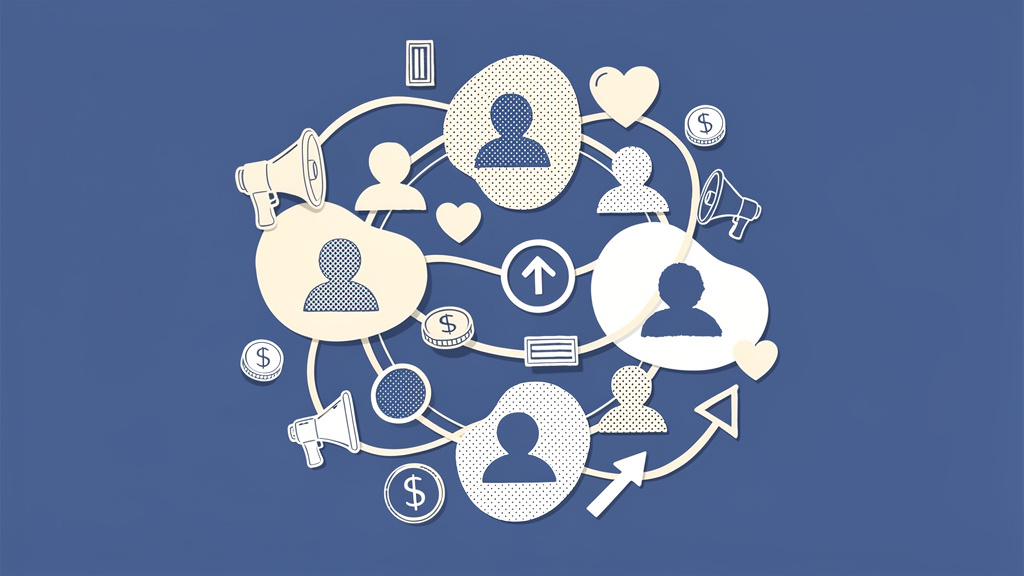
Peer-to-peer fundraising transforms your most passionate supporters into fundraising leaders, creating a ripple effect that traditional appeals simply can’t match. Instead of relying solely on your nonprofit’s direct outreach, P2P empowers individuals to create personal campaigns and solicit donations from their networks on your behalf, expanding reach and building authentic connections beyond your existing donor base.
This article will walk you through the fundamentals of P2P fundraising, show you why it outperforms traditional approaches, and give you practical strategies to launch campaigns that turn good intentions into measurable, scalable action.
Understanding the P2P Model
At its core, peer-to-peer fundraising lets supporters create personalized campaign pages where they share their stories, set goals, and track progress. These pages are typically tied to events like charity runs, birthday fundraisers, or personal challenges, but honestly, the possibilities extend far beyond traditional events.
Your nonprofit provides the infrastructure (customizable templates, leaderboards, social sharing tools) while fundraisers bring their authentic voice and personal networks. Funds flow directly to your organization while fundraisers earn recognition, fostering a sense of ownership that drives repeat involvement.
This model, also called social fundraising, leverages something nonprofits can’t manufacture: the trust and influence your supporters already have within their communities.
Why P2P Outperforms Traditional Approaches
Look, the numbers tell a compelling story about efficiency and impact.
Donors give 2.5 times more through P2P campaigns than through direct appeals (WPExperts.io). Even more striking, 75% of P2P donations come from first-time givers, dramatically expanding your donor base (WPExperts.io). For organizations tired of chasing vanity metrics and overhead ratios, P2P delivers real, measurable growth.
Consider these benchmarks:
| Traditional Fundraising | P2P Fundraising |
|---|---|
| $128 average gift | $568 average gift |
| 27% donor retention | 50% donor retention |
| 22% campaign success rate | 71% campaign success rate |
| Internal reach only | Exponential network growth |
Source: WPExperts.io
Funraise users see even stronger results: P2P fundraisers average $1,220, nearly 10 times a standard one-time donation of $125 (Funraise Growth Statistics). The Cupcake Girls boosted their P2P revenue by 386% in their first full year after implementing proper infrastructure (Funraise Growth Statistics).
Protip: Don’t launch to your entire database at once. Start by recruiting 5-10 top advocates as “ambassadors,” provide them with training webinars, and let them model success before expanding to broader audiences.
The Daily Struggles We See (And How to Overcome Them)
Before nonprofits switch to purpose-built platforms, we consistently see these challenges:
The “Set It and Forget It” Failure: Organizations launch P2P campaigns with enthusiasm but provide minimal support after setup. Fundraisers create pages, share once on social media, then… nothing. Without ongoing communication, templates, and motivation, 60-70% of registered fundraisers never raise a single dollar.
The Technology Mismatch: Nonprofits cobble together separate tools for registration, donation processing, email, and reporting. Data doesn’t sync. Fundraisers get frustrated with clunky experiences. Staff spend hours manually reconciling information instead of coaching high-performers.
The Activation Gap: Organizations recruit hundreds of fundraisers but can’t identify who needs help versus who’s crushing goals. Without real-time dashboards and segmentation, you’re flying blind, unable to provide targeted support that could double or triple results.
Here’s the thing: even organizations using our platform sometimes fall into the trap of treating P2P as a one-off event rather than an ongoing strategy. The shift from “fundraising campaign” to “fundraising program” requires intentional systems, not just software.
Real Organizations, Real Results
Top US nonprofits demonstrate P2P’s versatility across causes and scales.
Brighton Jones Richer Life Foundation mobilized 60+ fundraisers for their #OneTeam for Kenya campaign, raising $211,383 for child aid organizations (Donorbox). Aligned Alliance turned a grueling 3,000-mile bike race into a $137,143 veteran support initiative with just 19 highly motivated fundraisers (Donorbox).
Even smaller organizations see outsized impact. Maya’s Hope Foundation raised over $30,000 for their Ukraine Emergency Fund through P2P, then added $176,798 through their Lotus Ball event using the same approach (Donorbox).
The unconventional approach? Heroes Rebellion Athletic Foundation runs year-round P2P, letting donors vote on which grants to fund. This creates sustained engagement rather than the exhausting sprint-and-crash cycle of event-based fundraising (Qgiv).
“The most successful nonprofits don’t just ask for donations; they create movements by empowering their supporters to become fundraisers themselves.”
Funraise CEO Justin Wheeler
Your AI-Powered P2P Campaign Planner
Ready to design your peer-to-peer strategy? Copy and paste this prompt into ChatGPT, Claude, Gemini, or your preferred AI assistant:
I'm launching a peer-to-peer fundraising campaign for [NONPROFIT NAME], which focuses on [CAUSE/MISSION]. Our typical donor gives [AVERAGE DONATION AMOUNT], and we have approximately [NUMBER] active supporters in our database.

Create a 90-day P2P campaign plan including:
1. Recruitment strategy for getting 50+ fundraisers activated
2. Three creative campaign themes tied to our mission
3. Week-by-week communication timeline for fundraisers
4. Incentive structure to motivate different performance levels

Focus on strategies that don't require a massive budget but can scale with our growth.
Variables to customize:
- [NONPROFIT NAME],
- [CAUSE/MISSION],
- [AVERAGE DONATION AMOUNT],
- [NUMBER].
While AI tools provide excellent strategic frameworks, in your daily work you’ll want solutions like Funraise that have AI functionality built directly into your fundraising platform, providing full context of your donor data, campaign performance, and organizational goals without switching between tools.
Launching Your Campaign: Beyond the Basics
Recruit strategically through segmented email campaigns, social media posts, and at in-person events, but focus on engaged donors who already demonstrate passion for your mission. These individuals have the credibility and motivation to succeed.
Provide frictionless tools for page creation. Every additional click or form field reduces activation rates. Set clear goals with visual thermometers that create urgency and motivation.
Integrate technology thoughtfully. Nonprofits using platforms with Facebook fundraising integration see an 83% boost in funds raised (WPExperts.io). Team-based P2P campaigns raise 60% more than individual efforts (WPExperts.io), so build team functionality into your campaign architecture from day one.
Protip: Campaigns featuring video content raise 4 times more than those without (WPExperts.io). Create 2-3 short video templates fundraisers can personalize. Don’t expect everyone to become a videographer from scratch.
The Technology Question You Can’t Ignore
Your P2P platform isn’t just a donation form. It’s the infrastructure that determines whether you’ll hit 20% activation or 75% activation, whether you’ll retain new donors or watch them disappear.
Purpose-built platforms like Funraise enable seamless P2P with integrated CRM, real-time reporting, automation, and features like Facebook integration and AI-powered insights. Organizations using comprehensive platforms see 73% year-over-year online growth compared to those patching together disconnected tools (Funraise Growth Statistics).
The platform should handle:
- customizable fundraiser pages that load fast on mobile,
- social sharing optimization (20% of Facebook P2P visitors donate [WPExperts.io]),
- leaderboards and gamification (driving 20% revenue increases),
- automated thank-you sequences and milestone celebrations,
- real-time dashboards tracking the 10 metrics that actually matter.
Funraise users achieve 50% form conversion rates, dramatically improving the donor experience while providing precise insights for optimization (Funraise Growth Statistics). And you can start for free with no commitments, testing the platform with a pilot campaign before scaling.
Protip: Before launching your full P2P campaign, A/B test your donation form elements. Funraise clients see a 12.1% monthly giving conversion lift from optimized pop-up forms (Funraise Growth Statistics).
Measuring What Actually Matters
Track these 10 core metrics through integrated dashboards:
Financial metrics: Total raised, average per fundraiser, cost per dollar raised, overall ROI
Engagement metrics: Active fundraisers (vs. registered), new donors acquired, donor retention rate, social shares generated
Growth indicators: Repeat participation rate (returners see 18% annual fundraising increases [Peer to Peer Forum]), team vs. individual performance
Beyond dollars, measure impact through stories collected, volunteer hours contributed, and advocacy actions taken. These qualitative metrics predict long-term sustainability better than single-campaign revenue.
The declining per-participant average of $244 in 2024 (Raisely) means focusing on activation rates becomes critical. A campaign with 76% activation at $244 per person outperforms one with 30% activation at $350 per person.
2025-2026: Where P2P is Heading
Digital and hybrid models dominate as Gen Z donors demand interactive, flexible giving experiences. Virtual and hybrid events boost retention by 16% compared to in-person only approaches (WPExperts.io).
AI forecasting tools predict campaign outcomes, helping you allocate resources before problems emerge. Mobile-first design is non-negotiable since the majority of social traffic and donations now happen on phones.
The unconventional trend? “Ongoing P2P” programs where supporters maintain year-round fundraising pages rather than limiting activity to annual events. This creates steady revenue streams and deeper relationships, though it requires more sophisticated supporter nurturing.
Protip: Segment your fundraisers by past giving behavior. High-value donors using integrated platforms like Funraise see outsized returns because the technology removes friction from their fundraising process.
Overcoming Common Obstacles
Low activation rates? Provide ready-made email and social media templates, host weekly coaching calls, and create tiered incentive structures that reward both effort and results.
Technology barriers? Choose scalable platforms that grow with you. The nonprofit that starts with free Funraise tools for 20 fundraisers can seamlessly scale to 2,000 without platform migration headaches.
Supporter burnout? Create micro-challenges like “make 10 phone calls in 24 hours” or “share your story on three platforms this week.” Quick wins build momentum better than overwhelming long-term goals.
From Intentions to Action
Peer-to-peer fundraising works because it aligns with how humans actually give: we trust recommendations from people we know far more than appeals from organizations. P2P campaigns achieve 39-71% success rates compared to just 22% for traditional direct giving (WPExperts.io).
The model turns your supporters’ good intentions into efficient, measurable action, exactly what capacity-building nonprofits need to scale impact without proportionally scaling overhead.
So start small, measure relentlessly, and empower your advocates to lead the charge. Test Funraise’s free tier to experience how purpose-built technology transforms P2P from chaotic experiment to predictable revenue stream.
Your supporters are ready to fundraise on your behalf. The question is whether you’re ready to give them the tools to succeed.
About the Author


8 Strategies to Build a Massive Recurring Giving/Monthly Donations Engine
Recurring giving might just be the most underleveraged tool in nonprofit fundraising. Not because organizations don't know it exists, but because most treat it like a checkbox rather than the strategic engine it can actually be. There's a real difference between having a "monthly donation option" and building a genuine sustainer program that donors feel…
Commercial Co Venture 101: A Guide to Brand Partnerships for Nonprofits
What Are Commercial Co-Ventures? A commercial co-venture (CCV) is basically a formal agreement between a for-profit business and your nonprofit to run a revenue-generating activity where a share of proceeds benefits your cause. In our experience, this approach has become increasingly common, and for good reason. Research shows that 89% of consumers would switch brands…

How to Practice Ethical Fundraising in the Age of Big Data and AI
Look, we've all heard the pitch. Organizations with Fundraising Intelligence raise an average of 7 times more online annually compared to those without (Funraise, 2024). Sounds amazing, right? But here's the thing: that technological power comes with responsibility. Your donors trust you with their data, their stories, their financial information. That trust? It's fragile. And…